

VIP System
High Rakeback
Zero-edge originals
Plinko guide · zero edge · provably fair

Game mechanics, RTP range, and volatility.
Zero edge selection
Maximize your winning potential by choosing games with 100% RTP


Test without risk
The Plinko demo is the best way to understand how ball trajectories, risk levels, and multipliers work before playing with real money.
Origins · mechanics · variants
From a TV game show segment to one of the most popular formats in crypto casinos

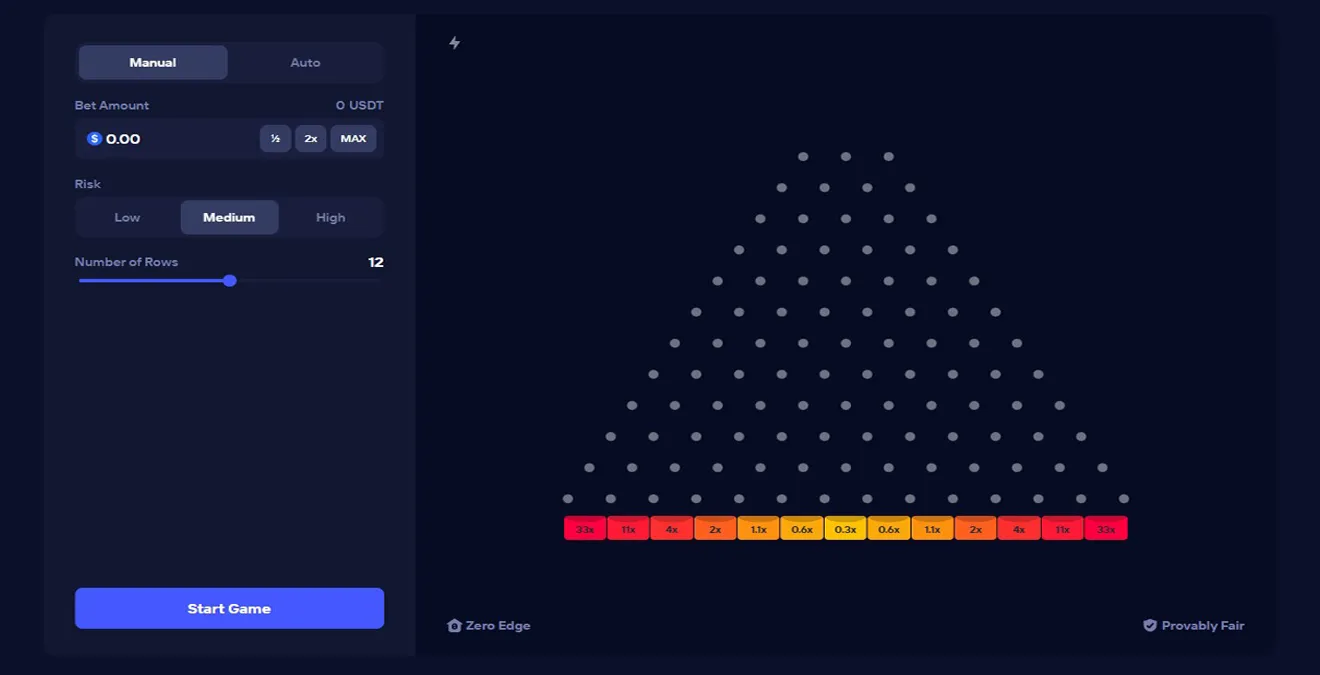
Plinko is a ball-drop game built around a pyramid of pins and a set of multiplier slots at the bottom. The player releases a ball from the top of the board, and gravity, combined with random bounces off the pegs, determines which slot the ball lands in and what the payout will be. There are no decisions to make once the ball is in motion - the outcome is purely physics-based randomness.
The concept became famous through the American TV show The Price is Right, where Plinko was introduced in 1983 as one of the most exciting pricing games. Contestants would earn chips and drop them down a large pegboard, watching as each chip bounced unpredictably toward prize slots. That segment became iconic and remains one of the most-watched moments in game show history.
The underlying principle behind Plinko is much older than television. It traces back to the Galton Board, a device invented by Sir Francis Galton in the 1870s to demonstrate the central limit theorem. When balls are dropped through a grid of evenly spaced pegs, they naturally distribute themselves into a bell curve at the bottom. This is the same binomial distribution that governs every Plinko game today.
When iGaming adopted this mechanic, the math stayed the same but the purpose changed entirely. Instead of illustrating probability theory, the Galton Board became a gambling format where the edges of the distribution represent rare but high-multiplier outcomes, while the center holds the most common and lowest payouts. This creates a natural risk-reward structure without any complex rules.
The migration of Plinko into crypto casinos accelerated this evolution. Platforms like Stake, Gamdom, and Duel built their own Plinko originals with adjustable parameters: number of rows, risk levels, and provably fair verification. The format proved to be a perfect fit for fast-paced crypto gambling, where transparency and instant results are valued above elaborate bonus mechanics.
Every Plinko board is defined by two core settings: the number of rows and the risk level. More rows mean more pegs and more bounces, which spreads the distribution wider and allows for higher maximum multipliers. Fewer rows keep the range tighter and the results more predictable.
Risk levels control where the multiplier values are placed along the bottom slots. On low risk, the extreme edges still pay more than the center, but the difference is moderate. On high risk, the center slots may pay as little as 0x while the outer edges can reach 1,000x or more. The shape of the probability curve does not change - the same Gaussian pattern applies - but the stakes assigned to each slot shift dramatically.
This dual-parameter system is what gives Plinko its depth. A player choosing 8 rows on low risk gets a mild, steady experience with small swings. A player on 16 rows with high risk enters a lottery-style mode where most drops return very little, but a single lucky bounce to the edge can deliver a massive payout. Understanding how these two levers interact is the foundation of any meaningful Plinko strategy.
Today, Plinko exists in dozens of variations from different providers and casino platforms. The most recognized studio versions come from BGaming, Spribe, and Hacksaw Gaming, each with their own visual style, row configurations, and RTP settings.
On the crypto side, platforms have built proprietary Plinko games as part of their Originals lineup. Gamdom Plinko and Duel Plinko stand out by offering 100% RTP configurations, where the multiplier table is set without any built-in house edge. Other platforms like Stake offer a 99% RTP version that is considered the benchmark for the classic format.
The key differences between versions come down to RTP, row range, risk level options, maximum multiplier, and whether the game is provably fair. Some versions also vary in visual execution - from minimalist pin boards to animated environments with sound effects and particle trails. But underneath the surface, the math follows the same binomial distribution regardless of the skin.
Game psychology
The appeal of watching a ball decide your fate
Plinko taps into something deeply satisfying: the visual anticipation of an outcome you cannot control. Unlike card games or grid-based formats where the player makes decisions during the round, Plinko compresses all the suspense into a single moment - the drop. Once the ball is released, there is nothing left to do but watch, hope, and react.
That passivity is paradoxically what makes the game so engaging. The ball bounces left, then right, then left again, and with every peg it hits, the potential outcome shifts. A ball heading toward the 1,000x edge can suddenly bounce back to the center at the last moment. This visual drama, built from pure physics and probability, creates an emotional intensity that many action-heavy games struggle to match.
Combined with the instant nature of each round and the ability to adjust risk before every drop, Plinko offers a rare combination: zero in-game decisions with full pre-game control. That is exactly the loop that keeps players coming back.
A clear comparison of Plinko games from major providers and casino originals, covering RTP, multiplier range, and provably fair status.
| Game | Provider | RTP | Max Multiplier | Rows | Risk Levels | Provably Fair |
|---|---|---|---|---|---|---|
| Plinko | Stake Original | 99% | 1,000x | 8-16 | Low/Med/High | Yes |
| Plinko | BGaming | 97-99% | 1,000x | 8-16 | Low/Normal/High | Yes |
| Plinko | Spribe | 97% | 555x | 8-16 | Green/Yellow/Red | Yes |
| Plinko | Hacksaw Gaming | 96.78% | 3,843.3x | Varies | Varies | No |
| PlinkoX | SmartSoft | 97% | 500x | 8-16 | Low/Med/High | Yes |
| Turbo Plinko | Turbo Games | 97% | 1,000x | 8-14 | Low/Med/High | Yes |
| Plinko Rush | Betsoft | 96% | 100x | 8-14 | Low/Med/High | No |
| Gamdom Plinko | Gamdom Original | 100% | 1,000x | 8-16 | Low/Med/High | Yes |
| Duel Plinko | Duel Original | 100% | 1,000x | 8-16 | Low/Med/High | Yes |
Math & zero edge
How Duel and Gamdom removed the casino edge from their Plinko originals.
In a standard Plinko game, the multiplier values assigned to each bottom slot are calibrated so that the long-term average return stays below 100%. The house edge is hidden in the gap between theoretically fair payouts and the actual numbers on the board. Over thousands of drops, that small margin adds up and represents the operator's profit.
A 100% RTP version of Plinko works differently. The multiplier table is recalculated so that the expected value of every drop, weighted by the probability of landing in each slot, equals exactly the bet amount. There is no margin built into the math. The Gaussian distribution still applies, the ball still bounces randomly, and individual sessions can still end in profit or loss - but the long-term mathematical expectation is perfectly balanced.
At Duel Casino, Plinko is part of their zero-edge Originals lineup. The multiplier tables are set to deliver 100% RTP with full provably fair verification. Every drop can be independently audited using blockchain-based seed pairs.
Gamdom takes a slightly different approach. Their Plinko game is built with 99% RTP in the base math, with the remaining 1% returned through their rakeback system. The effective RTP for active players reaches 100%, though the mechanism involves an indirect return rather than a pure zero-edge multiplier table.
Zero-edge Plinko does not change how the ball falls. It changes who keeps the mathematical surplus over time - and in a 100% RTP version, no one does.
Important about zero edge
100% RTP is not a guarantee of winning
Explore other original formats where operators offer zero-edge or max-RTP configurations.







Gameplay & discipline
While you cannot control the ball, you can control your setup, your bankroll, and your approach to risk
Plinko is one of the simplest casino games to understand: drop a ball, watch it bounce, and collect the multiplier it lands on. But behind that simplicity lies a set of decisions that shape your entire session before the ball even falls.
Set a stake that fits your bankroll. Plinko rounds are fast, so a smaller bet per drop lets you play more rounds and smooth out variance over time.
More rows mean a wider distribution and higher potential multipliers. Fewer rows keep outcomes concentrated near the center. Start with 8-10 rows to get comfortable.
Low risk gives frequent small returns. High risk concentrates value on the edges, creating a lottery-like experience. Medium is a balanced middle ground.
Release the ball from the top. Gravity and peg collisions determine where it lands. There is no skill involved during the drop itself - only the setup matters.
After each drop, evaluate your results and adjust your settings if needed. Track your session balance and avoid chasing losses by changing to higher risk impulsively.
The table below shows the highest possible multiplier for each combination of row count and risk level. Higher rows and higher risk unlock larger edge multipliers, but the probability of reaching them decreases sharply.
Begin your sessions on low risk with 8-10 rows. This gives you time to understand the distribution pattern and manage your bankroll before increasing variance.
Keep your bet size constant across drops. Flat betting prevents emotional escalation and ensures your bankroll lasts through natural variance swings.
The vast majority of drops land in the center. High-risk edge multipliers look attractive but hit extremely rarely. Know the math before committing to aggressive setups.
Decide your loss limit and profit target before you start dropping balls. Plinko rounds are fast and addictive - having clear boundaries protects your bankroll.
Before committing real money, test different row and risk combinations in demo mode. Watch how the distribution behaves over 50-100 drops to build intuition.
The biggest mistake in Plinko is chasing losses by jumping to high risk. The game has no memory - past drops do not influence future outcomes. Stay disciplined.
Psychology of the game
It is not just about the multipliers. Plinko works on the level of visual anticipation, simplicity, and the thrill of randomness.
Watching the ball bounce through the pegs creates a uniquely satisfying experience. Every collision shifts the trajectory, and the final slot feels like a verdict delivered by physics itself.
There are no complex rules, no card counting, and no optimal play charts. Anyone can understand Plinko in seconds, making it one of the most accessible casino games ever created.
Rows, risk level, bet size - every meaningful decision happens before the ball is released. That pre-game control combined with post-drop helplessness creates a compelling emotional loop.

Answers that matter
The most common questions about Plinko mechanics, RTP, risk levels, and choosing the right version.
Plinko is a ball-drop game where you release a ball at the top of a pin pyramid. It bounces randomly through the pegs and lands in a multiplier slot at the bottom. Edge slots pay more, center slots pay less. You control the risk by choosing the number of rows and the risk level before each drop.
No. Once the ball is released, the outcome is entirely determined by physics and random peg collisions. The only decisions you make are before the drop: bet size, row count, and risk level.
Standard versions from Spribe and BGaming offer 96-99% RTP. Gamdom and Duel both offer Plinko with 100% RTP, meaning there is no built-in house edge in the multiplier table.
There is no single best setting. Fewer rows (8-10) give tighter, more predictable results. More rows (14-16) open up higher multipliers but increase variance. Most experienced players settle on 12-14 rows with medium risk.
At 100% RTP, the multiplier values in each bottom slot are calculated so the expected return per drop exactly equals the bet amount. The bell curve distribution still applies, sessions still vary, but over time the math takes nothing from the player.
Start with low risk. It delivers the most frequent returns and the smallest swings, which helps you learn the distribution pattern without draining your bankroll quickly.
The drop itself is pure luck. But choosing rows, risk level, and bet size involves real decision-making that shapes your entire session.